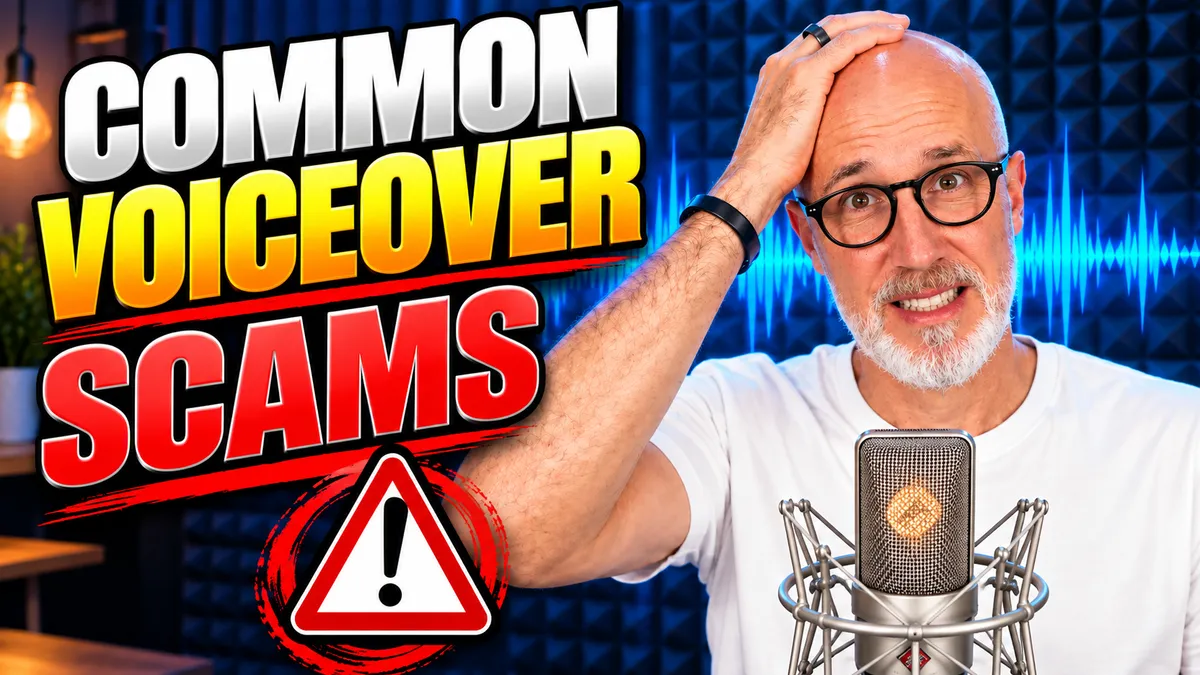
Why New Voice Actors Are Getting Scammed (And How to Stop It)
Why New Voice Actors Are Getting Scammed (And How to Stop It)
Top 5 Voiceover Scams Every Voice Actor Should Avoid
Voiceover is a fantastic business, but unfortunately, we're not immune to scammers.
In fact, I'd venture to say that voice actors can be particularly attractive targets.
Think about it. We're constantly marketing ourselves, sending out demos, looking for new clients and responding to audition opportunities. We want people to contact us about potential work.
And scammers know that.
They also know that newer voice actors are especially eager to land their first few jobs, which can make them more vulnerable to offers that sound too good to be true.
So today, I want to talk about five of the most common voiceover scams, how to recognize the warning signs and, most importantly, how to avoid becoming a victim.
Some of these scams can cost you thousands of dollars. Others can cost you your time, your work or even the rights to your own voice.
Let's get into it.
1. The Fake Client and Overpayment Scam
This is one of the oldest scams around, but it's been adapted specifically for the voiceover industry.
Here's how it typically works.
You receive an email out of the blue from someone claiming to be a producer or casting director.
They tell you they've listened to your demos and think you'd be perfect for an upcoming project.
Great news, right?
They might offer you $1,000 or more for a relatively simple recording session.
There's just one catch.
They want you to record at a local studio, and they'll supposedly cover the studio expenses.
So they send you a check for $1,500.
You're supposed to keep $1,000 for your voiceover services and send the remaining $500 to the studio or another person involved in the production.
Sounds simple enough.
Except there's a problem.
The check is fake.
You deposit the check, and your bank may initially make the funds available. You then send the $500 to the supposed studio.
A few days later, your bank discovers the check is fraudulent and reverses the deposit.
Now you're out $500 of your own money.
And the client?
Gone.
How to Spot This Scam
The biggest warning sign is when a supposed client asks you to send money to someone else as part of getting paid.
A legitimate client generally isn't going to overpay you and then ask you to redistribute the money.
Other red flags include unusually high rates for simple projects, unsolicited offers with very few details and pressure to deposit a check immediately.
My advice: Never send money to a client or third party simply because someone has promised to pay you for a voiceover job.
If a client needs to pay for a recording studio, they can arrange that directly with the studio.
You shouldn't have to act as their bank.
2. The Voiceover Demo Mill
This next one is something I've warned people about for years.
Demo mills.
Now, I want to make something clear.
Not every company that produces voiceover demos is a demo mill. There are plenty of excellent demo producers out there.
The problem is with companies that promise to turn someone with absolutely no experience into a professional voice actor in a matter of days.
Here's the typical pitch:
"Come to our three-day voiceover workshop! We'll teach you everything you need to know, record your professional demo and send you on your way to a successful voiceover career!"
Sounds pretty appealing.
Especially if you've been dreaming about becoming a voice actor.
But there's a serious problem.
You can't develop professional voiceover performance skills in a weekend.
Voice acting takes practice.
It takes training.
It takes learning how to interpret copy, take direction, develop conversational reads and understand what clients are looking for.
Those skills don't magically appear after a few days of instruction.
The $5,000 Mistake
Some of these programs charge thousands of dollars.
I've seen packages priced around $5,000 that promise training and a professional demo.
But what happens when the weekend is over?
You walk away with a demo that may sound professionally produced on the surface, but your actual performance skills haven't had time to develop.
And when you start marketing that demo to professional producers, you're competing against experienced voice actors with years of training.
That's a tough position to be in.
Even worse, some demo producers use heavy editing and production tricks to make an inexperienced performer sound better than they can consistently deliver.
That can create problems when a client hires you based on your demo and expects the same performance quality.
How to Avoid Demo Mills
Before investing in a demo package, ask some important questions.
How much training is included before recording?
Who determines when you're ready to produce a demo?
Can you hear examples of demos they've produced?
Will you receive honest feedback if you're not ready?
Are they promising guaranteed work or unrealistic income?
A reputable demo producer should care about whether you're actually ready to record.
A professional demo should showcase skills you've already developed—not attempt to substitute for those skills.
Get the training first.
Develop your performance.
Then invest in a professional demo when you're ready.
3. The Pay-for-Representation Scam
Here's another one to watch out for.
Someone contacts you claiming to represent a talent agency or voiceover roster.
They tell you they're interested in representing you.
Fantastic!
But then they say there's an upfront fee to join their agency or be listed on their roster.
That's where you need to be careful.
Legitimate Agents Typically Get Paid When You Book
In traditional voiceover representation, your agent earns a commission when you book work covered by your representation agreement.
For example, if your agent brings you a $2,000 job and your agreed commission is 10%, the agent earns $200.
That's a normal business arrangement.
But if someone tells you that you need to pay hundreds or thousands of dollars just to be represented, that's a major red flag.
There may be legitimate administrative charges or separate roster services in some business arrangements, but paying an upfront fee is not the standard model for traditional talent agency representation.
Research the company carefully before agreeing to anything.
Watch Out for Commission Agreements, Too
There's another aspect of representation that I think deserves attention.
Some agencies want a percentage of every voiceover job you book.
Not just the jobs they bring you.
Every job.
Even if you found the client yourself.
I've personally been approached about this type of arrangement.
In one case, an agency was specifically recruiting voice actors who were already earning six figures.
Think about that business model.
If you sign a bunch of successful voice actors who already have established client relationships and collect a percentage of all their income, that can become a pretty profitable arrangement for the agency.
But is it a good arrangement for the voice actor?
That's something you need to decide.
Personally, I'm not interested in paying an agent a commission on work I've sourced and booked entirely on my own.
I'm happy to pay my agents their agreed percentage on the work they bring me.
But I don't want to give away a portion of every dollar I earn.
To be clear, broader commission arrangements aren't automatically scams. Some are legitimate contractual relationships. The important thing is understanding exactly what you're agreeing to.
Always read your representation agreement carefully, especially the sections covering commissions, exclusivity and independently sourced work.
4. The AI Voice Harvesting Scam
This is one of the newer concerns facing voice actors.
And with the rapid growth of artificial intelligence, it's something we all need to be aware of.
People attempting to collect voice recordings to create AI-generated versions of your voice.
Here's how it might happen.
Someone contacts you about a voiceover project.
They send you a script to record.
But when you look at the script, something seems strange.
Instead of a normal commercial, narration or explainer, it's a collection of unrelated sentences.
Maybe there are random phrases.
Numbers.
Unusual word combinations.
Sentences that don't seem to form any coherent story.
Why would someone want you to record something like that?
One possibility is that they're collecting audio to train or evaluate an AI voice model.
Not Every Unusual Script Is a Scam
It's important to understand that there are legitimate speech-data collection projects.
Companies working on speech recognition, accessibility technology and other applications may hire voice actors to record unusual scripts.
The problem isn't necessarily the script itself.
The problem is when someone misrepresents how your recordings will be used.
If a client tells you they're hiring you for a commercial but is actually collecting your voice to create an AI replica without your permission, that's a serious issue.
How to Protect Your Voice
If you receive a suspicious audition or recording request, ask questions.
What is the project?
Who is the end client?
Where will the recordings be used?
Will the recordings be used for artificial intelligence training, voice cloning or synthetic speech?
What rights are you granting?
Are those rights limited to a specific project and usage period?
And most importantly, does the agreement allow your voice to be replicated or used to generate recordings you never actually performed?
Be especially careful with contracts containing broad language about perpetual rights, derivative works, synthetic voices or unrestricted use of your recordings.
AI voice work can be a legitimate source of income when the terms are transparent and fairly negotiated.
But your voice is your livelihood.
Don't give away rights you don't understand.
5. The "We'll Pay You in Exposure" Scam
This last one isn't always technically a scam.
But it's something I think every voice actor should be cautious about.
You've probably heard some version of this:
"We don't have a budget for voiceover, but this project is going to be seen by millions of people!"
Or:
"We can't pay you, but we'll give you credit!"
Or my personal favorite:
"This could lead to lots of paid work in the future!"
Maybe.
But here's the problem.
Exposure doesn't pay the mortgage.
You can't take exposure to the grocery store.
You can't pay your electric bill with a credit in somebody's YouTube video.
And there's no guarantee that any of that supposed exposure will actually lead to paying clients.
Remember the Three T's of Voiceover
When it comes to determining your value as a professional voice actor, I like to talk about what I call the three T's:
Time. Training. Talent.
Those are the things you're bringing to the table.
Time: You're dedicating time to recording, editing, communicating with clients and delivering a finished product.
Training: You've invested time and money into learning your craft, improving your performance and developing professional skills.
Talent: You're bringing your unique voice, interpretation and ability to communicate a message effectively.
Clients aren't simply paying you for the five minutes you spend behind the microphone.
They're paying for everything it took to develop the ability to deliver that recording professionally.
When Is Free Work Okay?
Now, I'm not saying you should never work for free.
There are certainly situations where donating your services makes sense.
Maybe you're helping a nonprofit organization you believe in.
Maybe you're doing a favor for a friend.
Maybe there's a personal project you genuinely want to be involved with.
Those are your decisions to make.
But there's a big difference between choosing to donate your services and having someone pressure you into working for free with vague promises of future opportunities.
If a client has a commercial project that requires professional voiceover, they should generally have a budget for professional voice talent.
Don't be afraid to charge for your work.
How to Protect Yourself From Voiceover Scams
Although these five scams operate differently, there are some common warning signs worth remembering.
Be cautious when someone offers unusually high compensation for very little work, pressures you to make an immediate decision, refuses to provide verifiable company information or asks you to send money before receiving payment.
Pay attention to contracts, especially anything involving usage rights, AI training or representation commissions.
Research unfamiliar companies before accepting jobs.
And don't be afraid to walk away from an opportunity that doesn't feel right.
One of the best things you can do is develop a basic understanding of how legitimate voiceover businesses operate.
The more familiar you become with normal industry practices, the easier it becomes to recognize something unusual.
Don't Let Scammers Discourage You
I don't want this article to scare you away from pursuing voiceover.
There are plenty of legitimate clients, reputable agents, excellent coaches and professional demo producers out there.
I've spent decades working in this industry, and there are a lot of great people involved.
But just like any other business, voiceover has its share of people looking to take advantage of others.
And the more you know about how these scams work, the better prepared you'll be to avoid them.
Remember these five warning signs:
Fake clients and overpayment scams: Never send money back to someone who supposedly hired you.
Demo mills: Don't let anyone rush you into an expensive demo before your performance skills are ready.
Pay-for-representation schemes: Understand how your agent gets paid and exactly which jobs are subject to commission.
AI voice harvesting: Know how your recordings will be used and what rights you're granting.
Exposure offers: Don't confuse vague promises of future opportunities with actual compensation.
Your time, training and talent have value.
Protect them.
Want to Learn More About Starting a Voiceover Business?
If you're interested in becoming a voice actor or you're just getting started, I host a free Voiceover Blueprint webinar every Tuesday at 6:00 p.m. Pacific Time on Zoom.
We'll talk about some of the steps involved in starting a voiceover business, and you'll have the opportunity to ask me your questions live.
You'll also receive a free digital and audiobook copy of my book, The Voiceover Blueprint, plus four additional gifts just for attending.
You can register using the link in the description or pinned comment on my YouTube channel.
And if you're looking for more focused training, check out our Voiceover Blueprint programs page, where you'll find standalone courses covering topics like marketing, performance, technology, auditions and more.
Finally, if you're feeling overwhelmed by all the information about starting a voiceover business and can't figure out what to do next, I've created another video about how to overcome analysis paralysis and start moving forward in voiceover.
Because learning how to avoid scams is important.
But so is making sure fear and uncertainty don't prevent you from pursuing a legitimate opportunity.
Stay informed, protect yourself and keep building your voiceover business.
Download My Latest Beginner Mistakes in Voice Over - Quick Start! https://thevoiceoverblueprint.com/beginner-mistakes
Discover the Voice Over Blueprint™: https://thevoiceoverblueprint.com/vobp
The content on this channel is for educational and informational purposes only. While I share tips, strategies, and guidance based on my experience as a professional voice actor, there is no guarantee of earning income or securing voiceover work by using the information provided. Results vary depending on individual effort, skill level, market conditions, and other factors. Viewers should use their own judgment and take personal responsibility for their voiceover career decisions.

