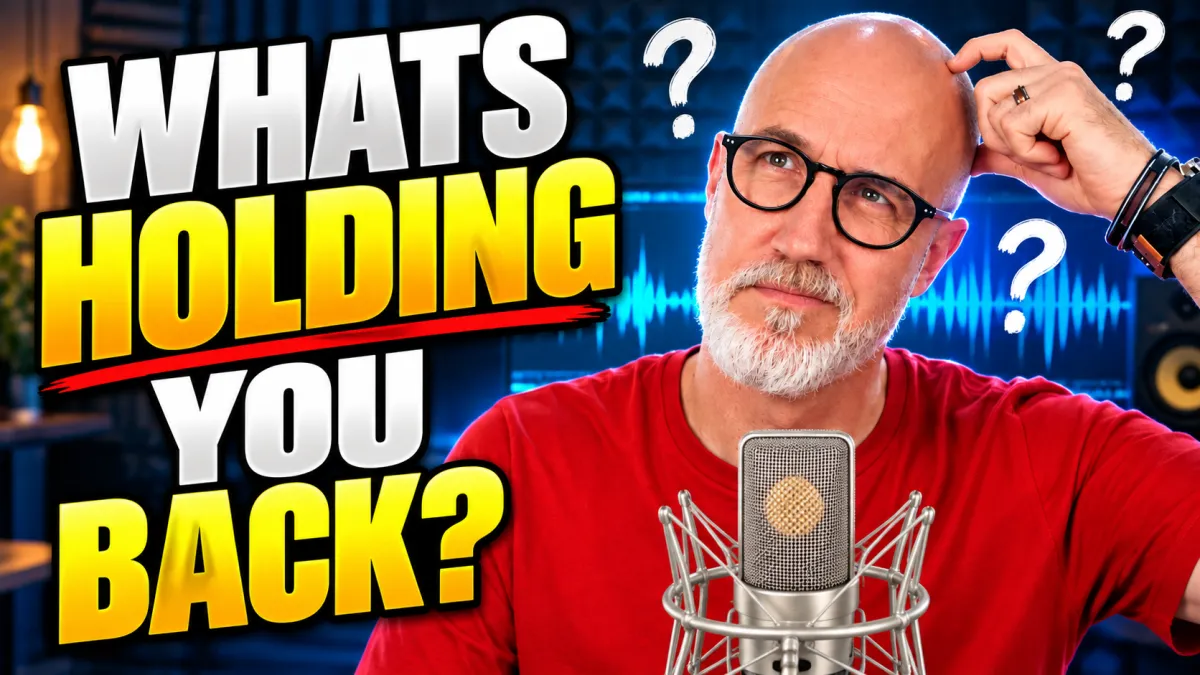
What’s Holding You Back from Full-Time Voiceover?
What’s Holding You Back from Full-Time Voiceover?
What's Holding You Back From Becoming a Voice Actor?
What's holding you back?
It's a simple question, but if your goal is to become a full-time voice actor, it's an important one to answer.
For a lot of people getting into voiceover, the dream is eventually to do this full-time. Maybe you want to leave your current job. Maybe you want more freedom in your schedule. Maybe you want to work from home doing something creative.
Or maybe full-time isn't your goal at all.
That's okay, too.
There's nothing wrong with building a profitable part-time voiceover business.
But if you do want to make voiceover a bigger part of your life and something keeps getting in the way, identifying that roadblock is the first step toward figuring out how to get around it.
Let's look at some of the biggest things that hold aspiring voice actors back—and what you can do about them.
1. "I Don't Have Enough Time"
This is probably one of the most common concerns I hear.
And I get it.
You have a job.
You have a family.
You've got kids, appointments, responsibilities, errands and all the other things that make up everyday life.
Where exactly are you supposed to find the time to build a voiceover career?
Here's the reality:
Building a voiceover business does take time.
And generally speaking, the more time you can dedicate to it, the faster you're probably going to progress.
But that doesn't mean you need 40 hours a week.
You don't even necessarily need 20.
If all you can dedicate to voiceover right now is 30 minutes a day, start with 30 minutes.
If you only have a few hours on the weekend, use those few hours.
Progress is still progress.
Think of Your Voiceover Career Like a Puzzle
Imagine putting together a giant puzzle.
What do most of us do first?
We find the edge pieces.
You start building the outside of the puzzle. Then you gradually begin filling in the middle.
One piece at a time.
For a while, it might not look like much.
But eventually you step back and realize:
Hey, this is starting to look like something.
Building a voiceover business works the same way.
Learning how to use your recording software is one piece.
Practicing your performance is another.
Improving your recording space is another.
Getting coaching is another.
Creating your demo is another.
Building your website is another.
Learning how to market yourself is another.
You don't have to complete the entire puzzle today.
You just need to put another piece in place.
Do that consistently and eventually you'll start seeing the bigger picture.
2. "I Don't Have Enough Money"
Another thing that stops people from pursuing voiceover is the belief that getting started costs thousands and thousands of dollars.
It certainly can.
You can buy an expensive professional booth.
You can buy a high-end microphone.
You can buy an expensive interface.
You can spend money on software, equipment, training and all kinds of other things.
And if you've got money to burn, knock yourself out.
But you don't have to start that way.
In fact, I usually don't recommend that a brand-new voice actor spend a fortune before they've made their first dollar.
You Can Start Small
You can put together a very basic practice setup relatively inexpensively.
Maybe you build a recording space using PVC pipe and moving blankets.
Maybe you convert a closet.
Maybe you buy an affordable USB microphone to start practicing.
There are even free recording programs available that allow you to begin learning the basics of recording and editing without spending money on software.
Depending on what you already own and the setup you choose, you may be able to create a basic starter setup for well under $500.
Is that necessarily going to be the studio you use five years from now?
Probably not.
But it doesn't have to be.
The goal is to start learning.
Then, as you begin generating income, you can reinvest some of that money back into the business.
Upgrade your equipment.
Improve your recording space.
Invest in coaching.
Get a professionally produced demo when you're ready.
You don't necessarily need to buy the finish line when you're standing at the starting line.
3. "I Don't Have the Skills"
Of course you don't.
You're new.
Nobody enters this business knowing everything there is to know about voiceover performance, recording, editing, auditioning, marketing and running a business.
These are learned skills.
And that's important because sometimes people hear professional voice actors and think:
"I'll never sound like that."
Well, you shouldn't expect to.
You're comparing your beginning to somebody else's middle—or possibly somebody else's 20th year in the business.
Voiceover performance is something you can learn.
Audio recording is something you can learn.
Editing is something you can learn.
Marketing is something you can learn.
Auditioning is something you can learn.
You don't need to know everything before you start.
Starting is how you eventually learn everything.
Training Can Shorten the Learning Curve
You can certainly figure out a lot of this stuff yourself.
There are countless free resources available online, including the videos on my YouTube channel.
But if you want to accelerate the process, good training and coaching can help.
A good coach can identify things you're doing that you may not recognize yourself.
A structured training program can also give you a roadmap so you know what to work on first, second and third instead of bouncing randomly from topic to topic.
Obviously, I'm partial to The Voiceover Blueprint because it's my program.
But whatever route you choose, get your information from people who actually understand the business and can help you develop the skills you're going to need.
Then practice.
And practice some more.
Eventually, things that initially seemed complicated become second nature.
4. "I'm Not Good Enough"
This one might be harder to overcome than time or money.
Self-doubt.
Imposter syndrome.
"Who am I to think I can become a voice actor?"
"Nobody is going to hire me."
"Listen to that person. I'll never be that good."
Most of us have dealt with some version of this.
The problem is that comparing yourself to established voice actors isn't particularly useful.
They didn't sound the way they do now when they started either.
You're hearing the result of years of experience, practice, coaching, auditions, mistakes, bookings, directed sessions and repetition.
Give yourself the opportunity to go through that process, too.
Instead of asking:
"Am I as good as that person?"
Ask:
"Am I better than I was six months ago?"
That's a much more useful comparison.
Confidence Usually Comes After Repetition
You don't necessarily become confident and then start doing the work.
A lot of the time, it's the opposite.
You do the work, and eventually the work creates confidence.
You record.
You listen.
You make mistakes.
You learn.
You record again.
You get coaching.
You audition.
You don't book.
You audition again.
Eventually you book something.
Then you book something else.
Little by little, the thing that once felt completely foreign starts feeling normal.
That's how confidence gets built.
It's a Marathon, Not a Sprint
It's an old saying because it's true.
Building a voiceover career is a marathon, not a sprint.
You're probably not going to become a successful full-time voice actor in a week.
That's okay.
Nobody is great at anything on Day One.
It takes time.
It takes training.
It takes practice.
It takes repetition.
And sometimes it takes getting knocked down a few times and deciding you're going to keep going anyway.
The important thing is consistency.
Even if you're only moving forward a little bit at a time, keep moving.
Those little steps start adding up.
Eventually, they can start to snowball.
What's Actually Holding You Back?
Maybe it's time.
Maybe it's money.
Maybe you don't think you have the skills yet.
Maybe you're dealing with self-doubt.
Maybe it's something completely different.
Whatever it is, don't look at that obstacle as proof that you can't become a voice actor.
Instead, ask:
"What's one thing I can do to move around this?"
You don't need to solve everything today.
Find one puzzle piece.
Put it in place.
Tomorrow, find another one.
And keep going.
Eventually, you may step back and realize that those tiny steps have turned into something that looks a whole lot like a voiceover career.
Download My Latest Beginner Mistakes in Voice Over - Quick Start! https://thevoiceoverblueprint.com/beginner-mistakes
Discover the Voice Over Blueprint™: https://thevoiceoverblueprint.com/vobp
The content on this channel is for educational and informational purposes only. While I share tips, strategies, and guidance based on my experience as a professional voice actor, there is no guarantee of earning income or securing voiceover work by using the information provided. Results vary depending on individual effort, skill level, market conditions, and other factors. Viewers should use their own judgment and take personal responsibility for their voiceover career decisions.

