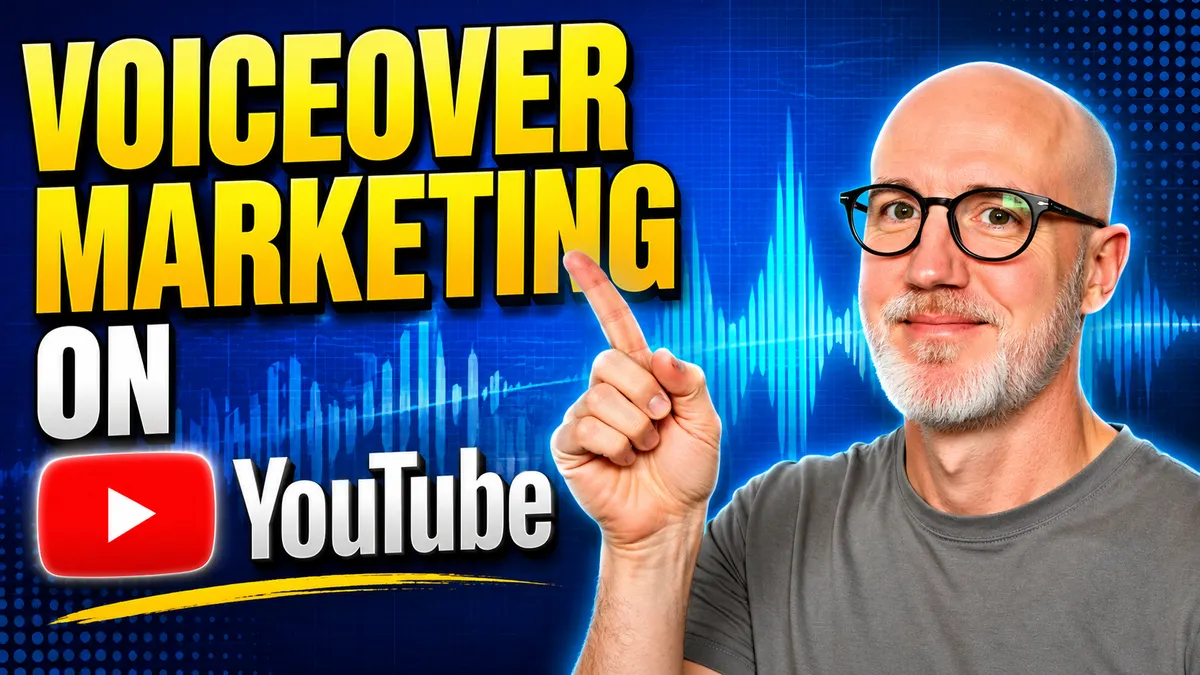
How to Use YouTube to Market Your Voiceover Business
How to Use YouTube to Market Your Voiceover Business
How to Use YouTube to Market Your Voiceover Business for Free
If you’ve followed me for a while, you’ve probably heard me talk about what I call the three-legged stool of voiceover.
Those three legs are:
Sound Quality. Performance. Marketing.
The reason I use the three-legged stool analogy is pretty simple: take away any one of those legs and the whole thing falls over.
You can have incredible sound quality and be a fantastic voice actor, but if nobody knows you exist, it’s going to be very difficult to build a profitable voiceover business.
That’s why today I want to focus specifically on voiceover marketing—and more importantly, how you can use YouTube to market your voiceover business without spending any money.
There are actually several ways YouTube can help your voice acting career, and some of them you may not have considered.
Why Marketing Matters for Voice Actors
One of the biggest mistakes new voice actors make is assuming that once they have a microphone, a recording space, and a demo, the work will simply start showing up.
Unfortunately, it usually doesn't work that way.
Voiceover is a business.
And just like any other business, potential customers have to be able to find you, hear what you can do, and understand why they should hire you.
That's where marketing comes in.
YouTube gives you another place online where potential clients can discover your work. And because creating a YouTube channel is free, it's something almost every voice actor can take advantage of.
Here are several ways you can use it.
1. Use YouTube's Free Music and Sound Effects
The first tip isn't technically marketing, but it can still help you run your voiceover business.
YouTube provides a library of music and sound effects that creators can use in their projects.
This can be especially useful when you're producing something for a client that needs a music bed or sound effects.
For example, you might be producing:
A podcast intro
An IVR or phone system
A corporate video
A promotional piece
Social media content
There are plenty of excellent paid music libraries available, and I personally use paid services as well. But if you're just getting started and working on a limited budget, YouTube's library can be another resource worth checking.
You can find it inside YouTube Studio by looking for the Audio Library or Creator Music section.
Just make sure you check the licensing requirements for the individual track you're using, particularly if the finished project is for a client.
2. Upload Your Finished Voiceover Projects
This is where YouTube becomes a true marketing tool.
Whenever possible, get copies of the finished projects you've voiced and add them to your own YouTube channel.
Maybe you narrated a commercial.
Maybe you voiced a corporate explainer.
Maybe you recorded a product video.
If the client sends you the completed video and you have permission to showcase it, upload it to your own channel.
Why?
Because you don't control what happens to the client's website or YouTube channel.
The company could redesign its website. They could remove the video. They could close their YouTube channel. The company itself could even go out of business.
Suddenly, a great example of your work disappears.
Keeping approved copies of your work gives you a portfolio that you control.
One important caveat: always make sure you have the appropriate rights or permission to repost client work. Just because a commercial or video appears publicly on someone else's YouTube channel doesn't automatically mean you have permission to download and republish it on yours.
When in doubt, ask the client.
3. Put Your Voiceover Demos on YouTube
Your professional voiceover demos should absolutely be part of your YouTube presence.
If you've had a video version of your commercial demo created, great. Upload it.
But you don't necessarily need an elaborate video.
You can create a simple video using your demo audio along with a static image containing your:
Name
Logo
Website
Contact information
The important thing is that your demo becomes another searchable piece of content that potential clients can discover.
You might title the video something like:
Mike Hathcote – Professional Commercial Voiceover Demo
Then include information in the description about the types of voiceover work you provide and, most importantly, how someone can hire you.
Don't make potential clients hunt for your contact information.
4. Connect YouTube With Your Voiceover Website
Your website should be the central hub of your voiceover business.
YouTube can help drive people there.
Make sure your YouTube presence includes a link back to your professional voiceover website. Then, on your website, link to your YouTube channel where appropriate.
Do the same thing with your other professional profiles, including platforms such as LinkedIn, Facebook, Instagram, and other places where you maintain an active business presence.
The larger goal is to create a connected online presence.
Someone might discover you through a YouTube video, click through to your website, listen to your demos, and eventually contact you for a job.
That's exactly what you want.
One clarification that's important from an SEO standpoint: these links can help search engines and people discover and understand your online presence, but simply linking a YouTube channel to your website doesn't automatically give your site a major ranking boost. Think of it as part of building a consistent, discoverable brand across the web, rather than an SEO shortcut.
5. Show People What It's Like to Work With You
You don't have to turn yourself into a full-time YouTuber to use video effectively.
You can simply show people what you do.
Set up your phone or camera and record some behind-the-scenes content from your studio.
Show people your recording booth.
Talk about your microphone.
Show your editing process.
Explain how you handle directed sessions.
Talk about a project you're working on—assuming you're allowed to discuss it.
You could even create a simple "Day in the Life of a Voice Actor" video.
This type of content accomplishes something that a traditional voiceover demo can't.
It allows potential clients to get to know you.
They're not only hearing your voice. They're seeing how you work, learning about your studio, and getting a sense of what it might be like to work with you.
That can be a powerful marketing tool.
You Don't Need Thousands of YouTube Subscribers
Here's another thing I think voice actors sometimes misunderstand about YouTube.
You don't need to become a huge YouTube creator for this strategy to work.
You're not necessarily trying to get a million views.
If a video gets 75 views but one of those viewers becomes a recurring voiceover client, that could be worth thousands of dollars over the course of that relationship.
That's a successful video.
Think about YouTube as another piece of digital real estate for your voiceover business.
Every demo you upload, every finished project you showcase, and every behind-the-scenes video you create gives someone another opportunity to discover you.
And most importantly, it costs you nothing to start.
Don't Ignore the Marketing Leg of Your Voiceover Business
Remember the three-legged stool.
Sound Quality. Performance. Marketing.
You need all three.
You can have a $3,000 microphone and a perfectly treated studio.
You can spend years developing your performance skills.
But if you aren't consistently putting yourself in front of potential clients, you're missing one of the most important pieces of building a sustainable voiceover career.
YouTube is just one marketing tool, but it's a powerful one because it allows you to showcase both your voice and the person behind the voice.
So if you already have a YouTube account, start using it.
Upload your demos.
Showcase your work.
Create some behind-the-scenes content.
Connect it with your website.
Give potential clients another way to find you.
Because the more places your voiceover business can legitimately be discovered, the more opportunities you create to get found, get heard, get hired—and get paid.
Want to Learn How to Become a Voice Actor?
If you've always wanted to get into voice acting but aren't sure where to begin, I host a free live voiceover webinar every Tuesday at 6:00 p.m. Pacific Time.
We'll walk through the steps involved in becoming a voice actor, and you'll have an opportunity to ask me your voiceover questions live.
As a bonus for attending, you'll also receive a downloadable copy of my book, The Voiceover Blueprint, the audiobook version, and four additional free gifts.
The webinar is completely free.
Use the registration link below to reserve your spot, and I'll see you Tuesday night.
And if you're just starting your voiceover business and you're wondering whether you should use your real name, a business name, or even a stage name, check out my video on how to name your voiceover business next.
I also corrected two things from the transcript that could cause problems in a published article: I softened the claim that reciprocal YouTube links directly boost search rankings, and I removed the recommendation to download and repost client videos without explicit permission.
Ready to take the next step? I'm hosting a free 1-hour webinar this Tuesday night at 6:00 PM Pacific / 9:00 PM Eastern where I'll go deeper into everything it takes to start a voice acting career from home—including how to land your first gigs with little to no upfront cost. Plus, everyone who shows up gets a free copy of my book, The Voiceover Blueprint (audiobook and ebook). Sign up using this link.
Download My Latest Beginner Mistakes in Voice Over - Quick Start! https://thevoiceoverblueprint.com/beginner-mistakes
Discover the Voice Over Blueprint™: https://thevoiceoverblueprint.com/vobp
The content on this channel is for educational and informational purposes only. While I share tips, strategies, and guidance based on my experience as a professional voice actor, there is no guarantee of earning income or securing voiceover work by using the information provided. Results vary depending on individual effort, skill level, market conditions, and other factors. Viewers should use their own judgment and take personal responsibility for their voiceover career decisions.

