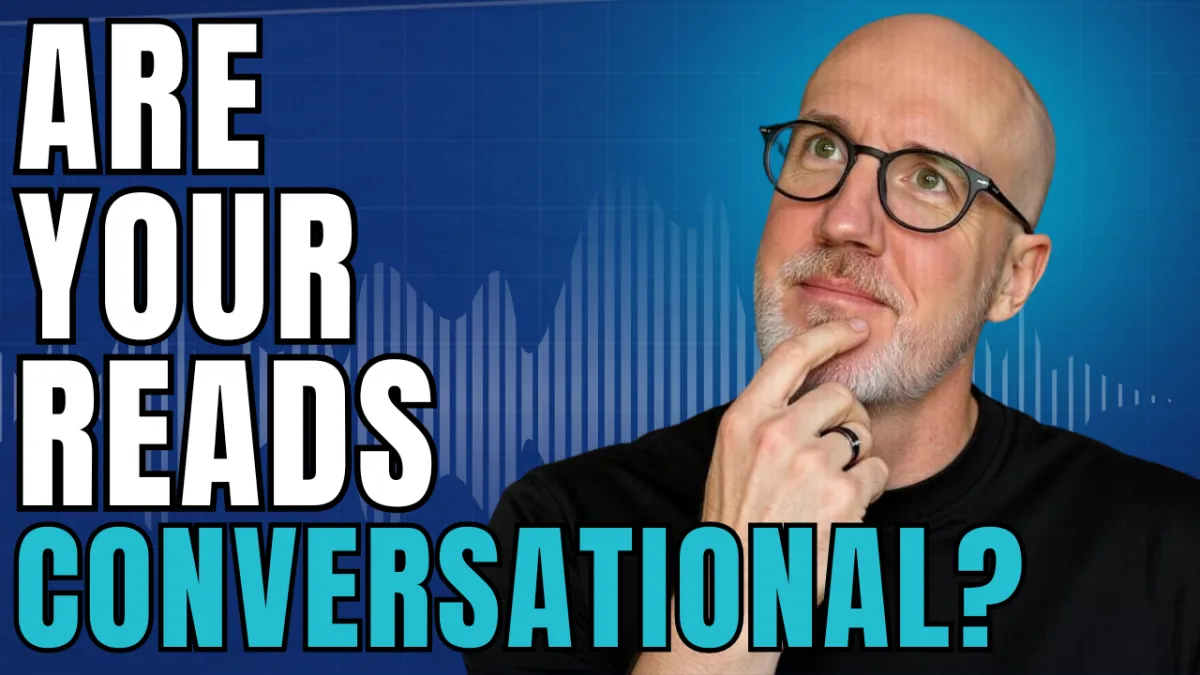
How to Sound More Conversational in Voiceover
How to Sound More Conversational in Voiceover
You Probably Don’t Sound Conversational Yet — Here’s How to Fix It
One of the most requested directions in voiceover today is:
“Can you make it sound more conversational?”
Clients want:
Real
Natural
Authentic
Guy-next-door or girl-next-door reads
But here’s the problem:
A lot of voice actors think they sound conversational… when they actually still sound like they’re reading.
And that may be exactly why they’re not booking as much work as they could be.
Because modern voiceover is no longer about sounding like an announcer.
It’s about sounding like a real person having a real thought.
The Real Goal of Conversational Voiceover
Voiceover is ultimately about sounding like you’re not reading — even though you are.
That’s the challenge.
The audience should never feel like you’re performing words off a page.
Instead, it should feel like:
You know what you’re talking about
The thoughts are naturally occurring to you
You’re speaking directly to one person
The message genuinely matters to you
That’s what conversational really means.
Stop Trying to “Read Better”
One of the biggest mistakes voice actors make is focusing too much on reading the script perfectly.
But conversational delivery is not about perfect reading.
It’s about believable communication.
Instead of trying to sound like a voice actor, focus on sounding like someone who actually understands and believes what they’re saying.
You need to become the subject matter expert.
Even though the words aren’t yours, they need to feel like they are.
Why You Still Sound Scripted
If you’re struggling to sound conversational, there are usually a few reasons why.
1. You’re Reading Instead of Communicating
When you obsess over every single word being technically correct, your focus shifts away from the message.
That’s when reads start sounding stiff and robotic.
The audience doesn’t connect to perfect pronunciation.
They connect to intention and meaning.
2. You’re Trying to “Sound Like a Voice Actor”
Many beginners have a preconceived idea of how voice actors are supposed to sound.
So they imitate:
Commercial announcers
Trailer voices
Other talent online
The problem is that modern voiceover rewards authenticity far more than performance.
Clients want you, not your “voice actor voice.”
3. You’re Overthinking Every Word
Yes, accuracy matters.
But when you overanalyze every syllable and squeeze the life out of every sentence, the read becomes mechanical.
Natural conversation has flow.
It breathes.
It moves.
Real people don’t speak in perfectly polished paragraphs.
The Mental Shift That Changes Everything
Sounding conversational starts mentally before it starts technically.
You need to stop treating the script like someone else’s words.
Instead, treat it like your own idea.
Ask yourself:
Who am I talking to?
Why am I telling them this?
What do I want them to feel or do afterward?
That mental framing instantly creates more connection and realism.
Picture a Real Person
One of the simplest ways to sound more natural is to imagine an actual person while recording.
Picture:
Their face
Their reactions
Their personality
When you speak to a real person mentally instead of “performing into a microphone,” your delivery naturally relaxes.
You stop presenting.
And you start communicating.
The “Look Away” Method
One powerful technique for conversational reads is something called the “look away” method.
Here’s how it works:
Read the line silently first
Understand the meaning behind it
Look away from the script
Say it naturally as if the thought just occurred to you
This works especially well for:
Commercial copy
Short-form scripts
Conversational ad reads
The goal is to process the idea first instead of mechanically reading words.
The Springboard Technique
Another helpful trick is using a conversational “springboard” before the actual line.
For example, before reading the script, you might casually think or say:
“Oh man, this is actually really useful…”
“You know what’s interesting?”
“I didn’t expect this…”
This helps trick your brain into conversational mode instead of performance mode.
Use Hesitations Carefully
Natural speech isn’t perfectly smooth.
Sometimes thoughts develop in real time.
A slight pause or hesitation can make a line feel more authentic and human.
But this technique needs to be subtle.
Too many hesitations sound forced and unnatural.
Used sparingly, though, they create realism.
Contractions Make You Sound Human
A huge reason scripts sound stiff is because they’re often written formally.
Real people usually say:
“I’ve” instead of “I have”
“You’ll” instead of “You will”
“We’re” instead of “We are”
If the goal is a conversational read, using contractions often makes the script sound far more natural.
And in most cases, clients actually prefer it.
Don’t Force the Tricks
One mistake voice actors make is trying to apply these techniques mechanically.
You can’t force conversational delivery.
You have to feel it.
If you over-engineer:
Every hesitation
Every contraction
Every pause
The read will still feel artificial.
The goal is connection, not performance.
Conversational Voiceover Is About Connection
The biggest reason reads sound unnatural is because the actor is focused on performance instead of connection.
Anybody can read words.
Your job is to:
Translate those words into emotion
Create believable thoughts
Make listeners lean in
Make the message feel real
That emotional connection is what separates professional-level reads from beginner reads.
Small Imperfections Make You Sound Human
Ironically, tiny imperfections often make reads sound more authentic.
Things like:
Small breaths
Natural pauses
Slight conversational rhythm changes
Those are the things AI still struggles to replicate naturally.
Perfect isn’t always believable.
Human is believable.
How to Start Sounding More Conversational Today
Here’s a simple framework you can practice immediately:
1. Picture a Real Person
Stop reading to the microphone.
Start talking to someone.
2. Focus on the Message
Don’t obsess over individual words.
Communicate the overall idea.
3. Use Conversational Rhythm
Allow natural pacing, breaths, and flow.
4. Try the Look Away Method
Process the thought first, then speak naturally.
5. Use Contractions Naturally
Make the script sound like real speech.
6. Stop Trying to Sound Like a Voice Actor
Authenticity books more work than performance today.
Final Thoughts
Conversational voiceover is the name of the game right now.
And the good news is:
It’s a skill.
Not a talent.
You can absolutely train yourself to sound:
More natural
More authentic
More connected
More bookable
The more you practice communicating instead of performing, the more believable your reads become.
And when your reads start sounding like real thoughts instead of polished script reading, that’s when you truly begin sounding conversational.
Ready to take the next step? I'm hosting a free 1-hour webinar this Tuesday night at 6:00 PM Pacific / 9:00 PM Eastern where I'll go deeper into everything it takes to start a voice acting career from home—including how to land your first gigs with little to no upfront cost. Plus, everyone who shows up gets a free copy of my book, The Voiceover Blueprint (audiobook and ebook). Sign up using this link.
Download My Latest Beginner Mistakes in Voice Over - Quick Start! https://thevoiceoverblueprint.com/beginner-mistakes
Discover the Voice Over Blueprint™: https://thevoiceoverblueprint.com/vobp
The content on this channel is for educational and informational purposes only. While I share tips, strategies, and guidance based on my experience as a professional voice actor, there is no guarantee of earning income or securing voiceover work by using the information provided. Results vary depending on individual effort, skill level, market conditions, and other factors. Viewers should use their own judgment and take personal responsibility for their voiceover career decisions.

