

Voice Over Content Hub
Welcome to the content hub.
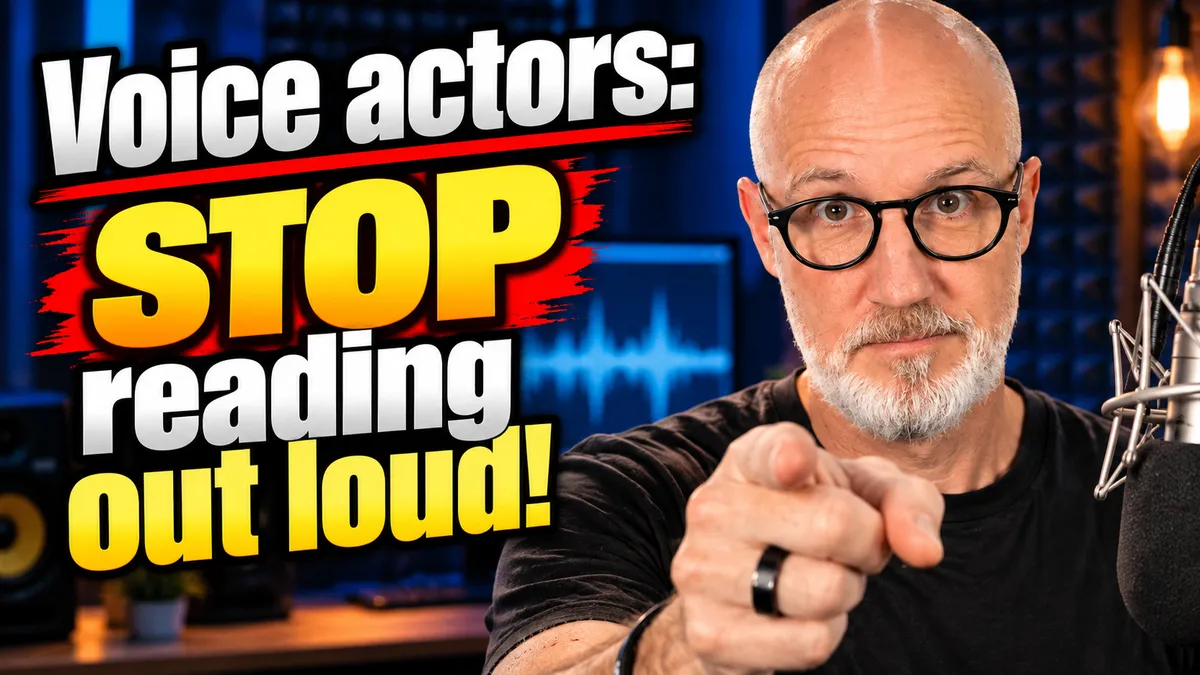
Why You Sound Like You're Reading (And How to Fix It)
Why You Sound Like You're Reading (And How to Fix It)
Voice Actors: Stop Reading Out Loud! Here's How to Sound More Natural
If you're a voice actor—or you're thinking about becoming one—I've got an important piece of advice for you.
Stop reading out loud!
I know that sounds strange. After all, isn't reading scripts what voice actors do?
Well, yes. But here's the difference.
Great voice actors don't sound like they're reading. They sound like they're talking.
And learning that distinction is one of the most important skills you can develop in voiceover.
The Problem With Sounding Too Perfect
What prompted this discussion was an audiobook I recently started listening to by Andrew Huberman, a neuroscientist and podcast host I've followed for years.
I'm a big fan of his podcast. He's excellent at explaining complicated subjects in a way that feels natural and conversational.
But when I started listening to his audiobook, something immediately stood out.
His delivery sounded much more like someone reading from a page than someone having a conversation.
Everything was carefully pronounced and precisely delivered.
In voiceover, I call that overcooking.
Overcooking happens when a voice actor becomes so focused on pronouncing every word perfectly that the performance loses its natural rhythm and personality.
The result can sound stiff, rehearsed, and sterile.
And here's the interesting part.
Huberman was reading his own words!
As voice actors, we're usually reading scripts written by somebody else. We often have to interpret material we're seeing for the first time.
That's why developing conversational reading skills takes practice.
Your Job Is to Sound Like You're NOT Reading
One of the biggest mistakes I see with new voice actors is treating a script like something they're supposed to read perfectly.
They pronounce every word.
They emphasize words that don't need emphasis.
They use overly formal pronunciation.
And they follow the punctuation so carefully that the delivery sounds mechanical.
But think about how you speak during a normal conversation.
You don't carefully pronounce every syllable.
You use contractions.
You naturally connect words.
You change your pacing and emphasis depending on what you're saying.
That's what we're trying to recreate in voiceover.
The goal isn't to read the words perfectly. It's to communicate the message naturally.
Here are five techniques that can help.
1. Try the Look-Away Method
This is one of my favorite techniques for creating conversational reads.
It's called the look-away method.
Here's how it works.
Instead of reading a sentence directly from the page, read it silently first.
Get the thought into your head.
Then look away from the script and say the sentence out loud from short-term memory.
Why does this work?
Because you're no longer concentrating on reading individual words.
You're communicating a thought you've already processed.
That small change can make a tremendous difference in your delivery.
This technique works particularly well with shorter commercial scripts and individual lines that are easy to remember.
2. Use the Springboard Method
Another technique I teach is something called the springboard method.
The idea is simple.
Before reading the actual script, make up a sentence or two that leads naturally into it.
For example, let's say your script begins:
"There's never been a better time to upgrade your home."
Instead of starting cold, you might say:
"You know, I was looking around my house the other day, thinking about all the things I'd like to change. And honestly..."
Then jump into the actual script.
Those extra words aren't part of the recording you're going to deliver.
They're just a way to get your brain into conversation mode.
Instead of thinking, I'm about to read a script, you're thinking, I'm already talking to someone.
That momentum can carry directly into your performance.
3. Stop Overpronouncing "A" and "The"
This is a big one.
Two of the most common giveaways that someone is reading rather than talking are the words "a" and "the."
In normal conversation, we usually use their reduced pronunciations.
For example:
"A" usually sounds like "uh," rather than "ay."
"The" often sounds like "thuh," rather than "thee."
Of course, there are exceptions. We naturally emphasize these words in certain situations, and "the" is often pronounced "thee" before a vowel sound.
But when voice actors consistently use the fully emphasized versions, their delivery can sound overly formal.
Listen to yourself the next time you record.
Are you saying the words the way you'd naturally say them in conversation?
Or are you pronouncing every word as though you're reading aloud in elementary school?
It's a small adjustment that can make a big difference.
4. Use Contractions Whenever Appropriate
Here's another simple way to make your voiceover sound more conversational.
Use contractions.
In everyday conversation, we rarely say:
"We have been working on this for a long time."
We're much more likely to say:
"We've been working on this for a long time."
The same goes for:
"Do not" becoming "don't"
"I am" becoming "I'm"
"You are" becoming "you're"
"We will" becoming "we'll"
Sometimes a script will have these words written out separately.
And if the client wants a natural, conversational delivery, it's often perfectly acceptable to turn them into contractions.
Just be sure the change doesn't alter the intended meaning or conflict with specific client instructions.
The point is to make the script sound like something a real person would actually say.
5. Soften Those Hard T's
Here's another subtle technique.
Pay attention to how you're pronouncing the letter T.
In American English, certain T sounds naturally become softer, almost like a D sound.
Take the word "ability."
In everyday American speech, the T often sounds more like a quick D.
But when people start reading from a script, they sometimes pronounce that T very sharply.
And suddenly, the word sounds overly precise.
This happens with plenty of other words, too.
Think about how you naturally pronounce words like "water," "better," or "city."
You probably don't hit every T with perfect textbook pronunciation.
And that's okay!
That softer pronunciation is part of how many Americans naturally speak.
Of course, pronunciation depends on the accent, the word, and the type of project.
But for conversational American voiceover, overly crisp consonants can sometimes make your performance sound less natural.
Perfection Is the Enemy of a Great Voiceover Performance
Here's what I really want you to remember.
Perfect pronunciation doesn't necessarily equal a great performance.
In fact, sometimes perfection is exactly what's holding you back.
Clients often want voice actors who sound relatable, believable, and conversational.
They want someone who can communicate a message without sounding like they're reading it off a piece of paper.
That doesn't mean being sloppy.
It doesn't mean ignoring the script or mumbling your words.
It means understanding the difference between reading words and communicating ideas.
The best voice actors make the listener forget there's a script involved.
And that takes training, practice, and a willingness to stop worrying about making every word sound perfect.
The Bottom Line: Talk, Don't Read
The next time you sit down to record an audition, try a few of these techniques.
Use the look-away method.
Try the springboard method.
Pay attention to your pronunciation of "a" and "the."
Use contractions where appropriate.
And stop hitting every T like you're giving a pronunciation lesson.
Most importantly, remember that you're not simply reading words.
You're having a conversation with the listener.
And the more naturally you can communicate that message, the more believable your performance will become.
Because whether you're recording commercials, corporate narration, or audiobooks, the same principle applies:
Stop sounding like you're reading. Start sounding like you're talking.
Ready to take the next step?
Join my FREE webinar every Tuesday at 6PM PT on Zoom to learn all about how to become a professional voice actor, PLUS get a free copy of my book "The Voiceover Blueprint: Get Found, Get Heard, Get Hired"
Sign up here: https://thevoiceoverblueprint.com/live-webinar
The content on this channel is for educational and informational purposes only. While I share tips, strategies, and guidance based on my experience as a professional voice actor, there is no guarantee of earning income or securing voiceover work by using the information provided. Results vary depending on individual effort, skill level, market conditions, and other factors. Viewers should use their own judgment and take personal responsibility for their voiceover career decisions.
Download my latest voice over resource guide...
Get My Latest Voice Over Tips, Tricks, and Insights You Can Use Right Now!
These no cost resource guides show you what working now in voice over.
Terms of Use. |. Disclaimer. |. Privacy Policy. |. Members Area. | Reviews | Refund Policy | Partners