

Voice Over Content Hub
Welcome to the content hub.
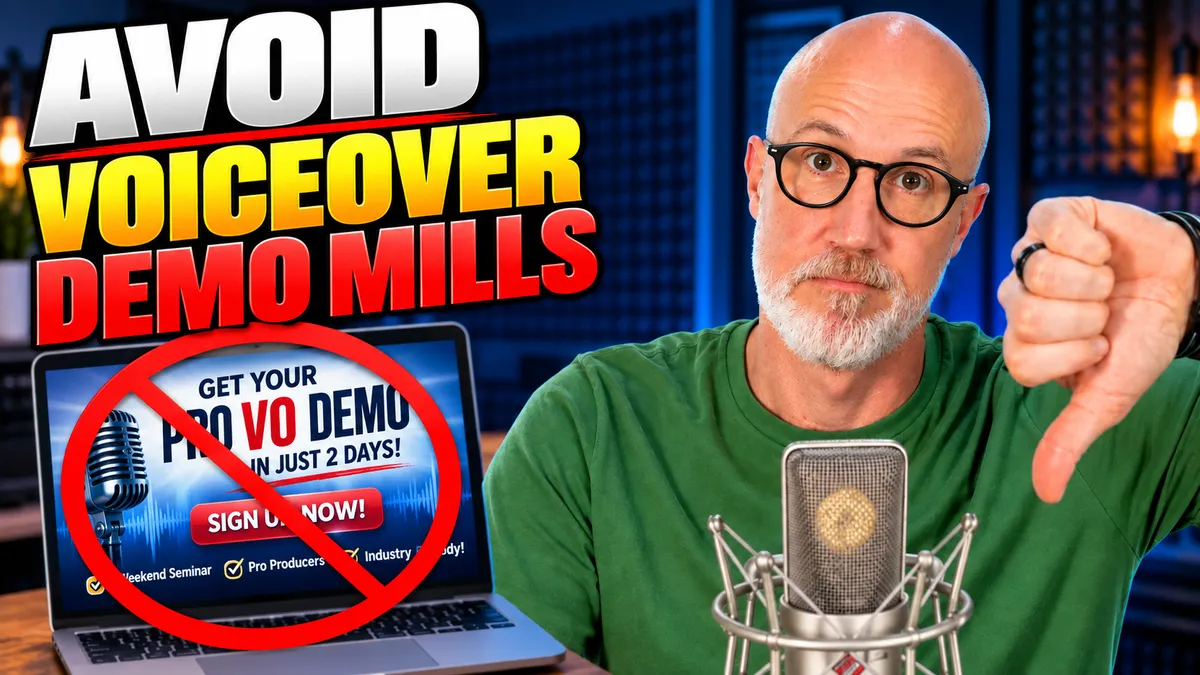
Why You Should Avoid Voiceover Demo Mills
Why You Should Avoid Voiceover Demo Mills
Voiceover Demo Mills: How to Avoid Wasting Thousands on a Bad Demo
If you're serious about building a professional voiceover career, you've probably heard me say this before:
You need a professional voiceover demo.
Your demo is one of the most important marketing tools you'll ever have. It's what you'll send to production companies, casting directors, agents, and potential clients to demonstrate your abilities.
But not every company offering professional voiceover demos is setting you up for success.
Some companies are more interested in collecting your money than making sure you're ready to compete in the industry.
These are what we call voiceover demo mills.
And if you're not careful, you could spend $5,000 or more and walk away with a demo that does very little for your career.
What Is a Voiceover Demo Mill?
A demo mill is a company that rushes aspiring voice actors through a short training program and immediately produces a supposedly professional demo.
Typically, you'll attend a weekend seminar or a few days of training, record your demo, and be sent out into the world to start your voiceover career.
Sounds great, right?
Except there's one major problem.
You can't develop professional voiceover skills in a weekend.
Voice acting requires practice, coaching, repetition, and experience. Just because someone hands you a professionally produced audio file doesn't mean you're suddenly ready to compete with experienced voice actors.
I've worked with students who've spent thousands on these programs, only to end up with mediocre demos that weren't competitive in today's marketplace.
The Problem With Line Reading
One of the biggest warning signs of a demo mill is something called line reading.
This happens when a producer reads a sentence and asks you to repeat it exactly the way they said it.
They tell you how to deliver every line, then edit everything together to make you sound professional.
The problem?
What happens when you get a real audition?
There's nobody there to tell you exactly how to perform every sentence.
You need to interpret the script yourself, make creative choices, and deliver a believable performance.
Your demo should showcase your actual abilities, not your ability to imitate someone else's performance.
And when a client hires you based on your demo, they'll expect you to deliver that same quality on the job.
That's why proper training needs to come before professional demo production.
What Should Professional Demo Production Look Like?
When I produce voiceover demos, I typically use a four-session process designed to create a competitive demo that accurately represents the talent.
Session 1: Script Selection
We start by choosing scripts that fit your voice, personality, and the types of jobs you want to book.
I like finding products and services you actually use or connect with.
Maybe you drive a Honda Accord or love Kraft Macaroni & Cheese.
Having a personal connection to the material can make your performance more authentic.
We also select scripts that demonstrate different styles and emotions, giving potential clients a better understanding of your range.
Session 2: Practice and Preparation
Next, we work through every script.
We refine the interpretation, pacing, emphasis, and conversational delivery.
The goal is to make sure you understand the material and can deliver believable performances before recording the final demo.
Session 3: Recording
Once you're prepared, we record the demo.
My clients typically record in their own home studios while I provide live direction through Zoom.
This closely resembles a real directed voiceover session, where a client listens and provides feedback.
You don't need to travel to an expensive New York or Los Angeles studio to produce professional-quality recordings.
Session 4: Review and Production
Finally, we review the recordings and select the strongest performances.
We also arrange the spots in an order that keeps listeners engaged.
You don't want two nearly identical reads back-to-back. You want variety that makes the listener wonder what else you can do.
Then we add appropriate music, sound effects, and professional production to create a demo that sounds like actual commercial work.
The finished product should sound professional while accurately representing what you can deliver for a paying client.
How Much Should a Professional Voiceover Demo Cost?
Professional demos commonly cost thousands of dollars, often starting around $2,500 and going considerably higher.
That's a significant investment.
But a great demo can become one of the most valuable marketing tools in your business.
You can use it on your website, send it to production companies, share it with agents, and include it in your direct marketing.
However, spending $5,000 doesn't automatically mean you're getting a better demo than someone spending $2,500.
And no demo, regardless of price, guarantees paying work.
The value comes from having a competitive demo that accurately showcases your abilities and helps you market yourself effectively.
Five Warning Signs of a Demo Mill
Before investing in a professional demo, watch for these red flags:
They promise you'll be demo-ready in a weekend. Professional performance skills take time to develop.
They guarantee you'll book work. No legitimate producer can promise that.
They rely heavily on line reading. Your demo should demonstrate your skills, not someone else's direction.
They don't evaluate your readiness. A reputable producer should tell you if you need additional training.
They emphasize their fancy recording studio. The finished product matters more than where it's recorded.
These warning signs don't automatically prove a company is dishonest, but they should encourage you to investigate before spending your money.
How Do You Know When You're Demo-Ready?
Before investing in a professional demo, you should be comfortable interpreting scripts, delivering different performance styles, and taking direction.
You should also be capable of consistently producing performances that match the quality of your demo.
You don't need to be perfect, but you do need to be competitive.
A qualified coach can help you determine whether you're ready.
And if you're not quite there yet?
Keep practicing.
Keep learning.
Keep improving.
A professional demo should be the result of developing your skills, not a shortcut around developing them.
The Bottom Line: Don't Rush Your Demo
Your professional voiceover demo is one of the most important investments you'll make in your career.
Don't let someone convince you that a few days of training are enough to prepare you for professional work.
Find a producer who will guide you through script selection, preparation, recording, and production.
Most importantly, make sure your demo accurately reflects the performances you can deliver consistently.
Because you don't just want a demo that sounds professional. You want one that helps you compete professionally.
Because a great demo can help open doors in your voiceover career.
But only if you've developed the skills to walk through them.
Ready to take the next step?
Join my FREE webinar every Tuesday at 6PM PT on Zoom to learn all about how to become a professional voice actor, PLUS get a free copy of my book "The Voiceover Blueprint: Get Found, Get Heard, Get Hired"
Sign up here: https://thevoiceoverblueprint.com/live-webinar
The content on this channel is for educational and informational purposes only. While I share tips, strategies, and guidance based on my experience as a professional voice actor, there is no guarantee of earning income or securing voiceover work by using the information provided. Results vary depending on individual effort, skill level, market conditions, and other factors. Viewers should use their own judgment and take personal responsibility for their voiceover career decisions.

Download my latest voice over resource guide...
Get My Latest Voice Over Tips, Tricks, and Insights You Can Use Right Now!
These no cost resource guides show you what working now in voice over.
Terms of Use. |. Disclaimer. |. Privacy Policy. |. Members Area. | Reviews | Refund Policy | Partners