

Voice Over Content Hub
Welcome to the content hub.
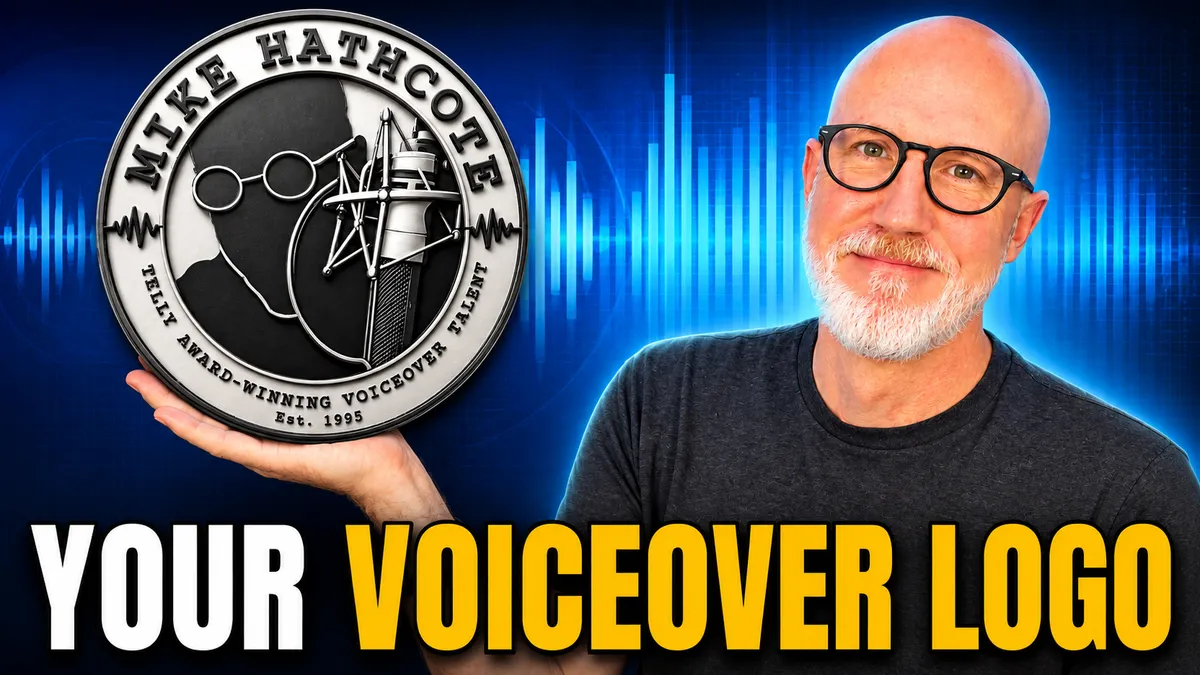
Voice Over Business Tips: Do You Need a Logo?
Voice Over Business Tips: Do You Need a Logo?
Do Voice Actors Really Need a Logo?
If you're starting a voiceover business, do you really need a logo?
The short answer is no.
But is having one a good idea?
I think it is.
A logo isn't going to get you hired because ultimately clients care about your voice, performance and ability to deliver what they need. But a good logo can help pull your overall brand together and make your voiceover business look more polished and professional.
Let's talk about why you might want one, where you can use it and a few relatively easy ways to create one.
A Logo Isn't a Requirement for Voiceover
When you're starting a voiceover business, there's a long list of things to think about.
You need to develop your performance skills. You need a recording space. You need equipment. Eventually, you'll need professional demos, a website and a way to market yourself.
Somewhere on that checklist, you may have written:
Create a logo.
Here's the important part: Don't let that become something that prevents you from moving forward.
You don't absolutely need a logo to become a working voice actor.
I've seen plenty of voice actors who don't have a traditional logo on their website or email signature.
That said, I personally think having one is a good idea.
A Logo Helps Build Your Voiceover Brand
One of the advantages of having a logo is that it gives your business a consistent visual identity.
Think about everything you're eventually going to put in front of potential clients:
Your website
Email signature
Social media accounts
Business cards
Marketing materials
Promotional items
Having the same logo and visual style across those different places helps tie everything together.
It can make your voiceover business feel like an actual brand rather than a collection of unrelated marketing materials.
And creating that brand can also be one of the fun parts of starting your business.
Your Logo Can Show Some Personality
There's no rule about what a voiceover logo is supposed to look like.
You'll certainly see plenty of microphones.
You'll see audio waveforms.
You'll see headphones.
But you don't have to use any of those things.
I've seen voice actors incorporate animals, characters and all kinds of other imagery into their logos.
Your logo can be an opportunity to communicate a little bit about your personality, the type of work you do or simply the visual style you want associated with your name.
You can make it clean and corporate.
You can make it fun.
You can make it vintage.
You can make it modern and minimalist.
It's your brand.
The important thing is to create something that represents you and that you won't mind looking at for a while.
Don't Let Your Logo Become More Important Than Your Voice
There's one warning I'd give here.
Don't spend so much time worrying about your logo that you neglect the things that actually make you money.
A great logo won't compensate for a bad demo.
It won't compensate for poor audio quality.
It won't compensate for weak performance skills.
And it won't magically bring clients to your website.
Your logo is part of the package. It's not the product.
You are the product.
Your voice, your performance and your ability to solve a client's problem are what ultimately matter.
The logo simply helps package and present your business professionally.
Where Can Voice Actors Use Their Logo?
Once you have a logo, you'll probably find more uses for it than you initially expected.
I use mine in several places, including my website, email signature and business cards.
You can also use yours across your social media profiles and other marketing materials.
The goal is consistency.
If someone visits your website after seeing one of your emails or social media profiles, having the same visual identity helps reinforce your brand.
It doesn't need to be complicated.
In fact, simple is often better.
Option #1: Hire a Graphic Designer
This is what I did.
I had an idea for what I wanted my logo to look like and hired a friend who is a graphic artist to create it for me.
If you already know a good designer, this can be a great option because you can explain what you're trying to accomplish and have someone translate that concept into a professional design.
A professional graphic designer can also provide your logo in the different file formats you'll need.
Ideally, you'll want versions that work on both light and dark backgrounds, along with a transparent-background version.
You'll also want a high-quality vector version when possible so the logo can be resized without losing quality.
Option #2: Create Your Own Logo With Canva
If you'd rather create your own logo, Canva is one place to start.
Canva offers both free and paid options and provides templates and design elements that can give you a starting point even if you don't consider yourself a graphic designer.
You can search for logo templates and then narrow the designs based on what you're looking for.
For example, search for something related to microphones or audio and you'll find plenty of starting points.
From there, you can change the wording, fonts, graphics, layout and other elements until you've created something that feels like your brand.
The nice thing about using a template is that you aren't necessarily starting with a completely blank screen.
You can find something that's 60% or 70% of the way toward what you want and customize it from there.
Option #3: Use Fiverr
Another option is Fiverr.
You can hire graphic designers directly through Fiverr, or you can experiment with its logo-making tools.
When using a logo maker, you'll typically start by entering information about your business.
For example:
Your name might be Mike Hathcote Voice Actor.
You could select voice acting as the industry and then choose some visual elements you'd like incorporated into the design—maybe a microphone, waveform or something completely unrelated to voiceover that represents your personality.
You can then select different design styles such as minimalist, vintage, 3D, geometric or hand-drawn.
From there, the system can generate different concepts for you to consider.
If you find something you like, you may be able to customize it further, purchase the design or work with a designer to make additional changes.
What Makes a Good Voiceover Logo?
Whatever method you use, I'd recommend keeping a few things in mind.
Keep it relatively simple. Your logo needs to work when it's large on a website but also when it's tiny in an email signature.
Make sure your name is readable. A beautiful logo isn't particularly useful if nobody can figure out whose business it represents.
Don't automatically use a microphone just because you're a voice actor. There's nothing wrong with microphone imagery, but there are thousands of voiceover logos using microphones. Think about whether there's something that could make yours more distinctive.
Make sure it works in different formats. You'll probably need horizontal, square and possibly icon-only versions.
Get a transparent version. This makes it much easier to place your logo on different backgrounds.
And most importantly, don't overthink it.
Your Logo Is Part of the Package
So, do you absolutely need a logo to become a successful voice actor?
No.
But I think it's worth having one.
A good logo can give your voiceover business a more consistent, professional appearance and help establish a visual identity across your website, emails, social media and other marketing.
Just remember where it belongs on your priority list.
Your performance comes first. Your audio comes first. Your demos and marketing come first.
The logo helps package everything together.
Want to Learn More About Starting a Voiceover Business?
If you're curious about voiceover but aren't sure where to begin, I host a free Voiceover Blueprint webinar every Tuesday at 6:00 p.m. Pacific Time.
We'll cover some of the steps involved in getting started in voiceover, and you'll have an opportunity to ask your questions about the business.
As a thank-you for attending, you'll also receive a downloadable copy and audiobook version of my book, The Voiceover Blueprint, plus four additional free gifts.
You can sign up using the link in the description or pinned comment on my YouTube channel.
Find out if you can actually make money in voice over → https://thevoiceoverblueprint.com/live-webinar
And if you're working on your voiceover brand, there's another question that usually comes right along with creating a logo:
Do you need a business name?
I've created a complete video covering voiceover business names, what you should consider when choosing one and whether you actually need one at all.
Download My Latest Beginner Mistakes in Voice Over - Quick Start! https://thevoiceoverblueprint.com/beginner-mistakes
Discover the Voice Over Blueprint™: https://thevoiceoverblueprint.com/vobp
The content on this channel is for educational and informational purposes only. While I share tips, strategies, and guidance based on my experience as a professional voice actor, there is no guarantee of earning income or securing voiceover work by using the information provided. Results vary depending on individual effort, skill level, market conditions, and other factors. Viewers should use their own judgment and take personal responsibility for their voiceover career decisions.

Download my latest voice over resource guide...
Get My Latest Voice Over Tips, Tricks, and Insights You Can Use Right Now!
These no cost resource guides show you what working now in voice over.
Terms of Use. |. Disclaimer. |. Privacy Policy. |. Members Area. | Reviews | Refund Policy | Partners