

Voice Over Content Hub
Welcome to the content hub.
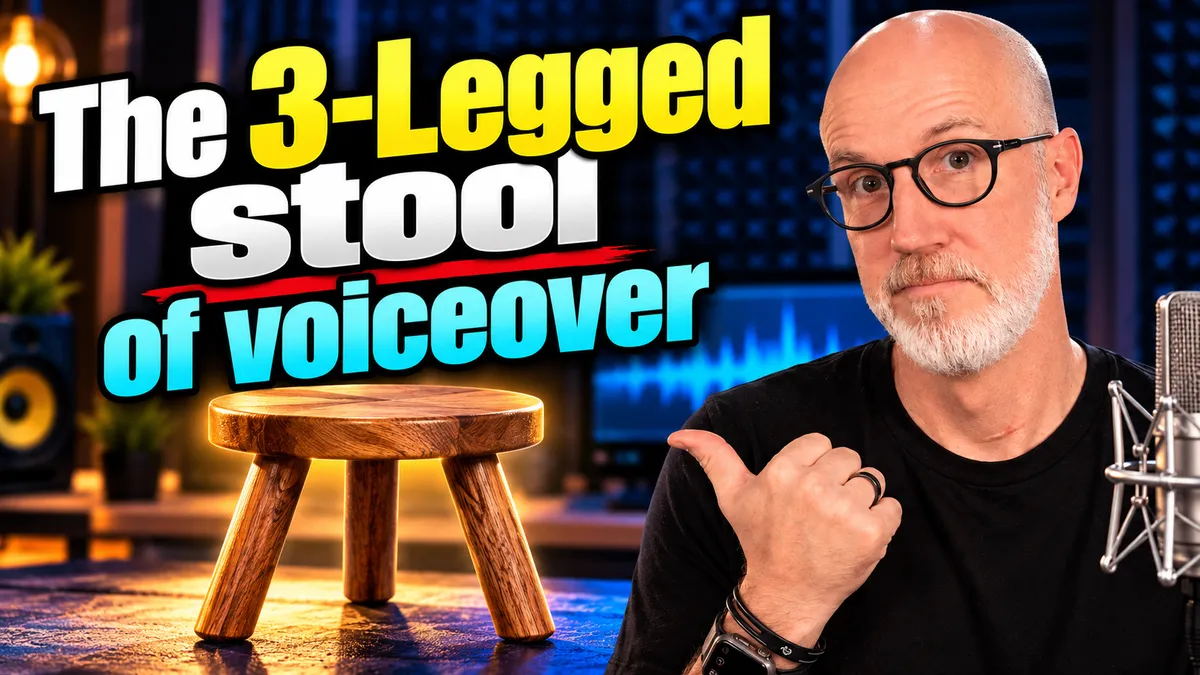
The 3 Legs of a Voiceover Business
The 3 Legs of a Voiceover Business
The 3 Pillars of a Successful Voiceover Business: Sound Quality, Marketing, and Performance
If you're serious about building a successful voiceover business, there are three things you absolutely must get right.
I call them the three-legged stool of voiceover success.
Why a three-legged stool? Because if you remove even one leg, the whole thing falls over.
The same principle applies to your voice acting career.
You can have the greatest voice in the world, but without the right skills and business strategy, you're going to struggle.
After years of working as a full-time voice actor, I've found that virtually everything comes down to three essential pillars:
Sound Quality
Marketing
Performance
Let's break down each one and explain why all three are critical to building a sustainable voiceover career.
Pillar 1: Professional Sound Quality
The first pillar of a successful voiceover business is sound quality.
Whether you're submitting an audition or delivering a finished project, your audio needs to meet professional standards.
And here's something that surprises many beginners:
Your recording space is more important than your microphone.
You can spend thousands on expensive recording equipment, but if you're recording in a room with echoes, reflections, and background noise, your audio will still sound amateur.
Start With Your Recording Space
Before investing in expensive microphones and interfaces, focus on creating a properly treated recording environment.
There are two important considerations.
1. Acoustic treatment
You want to minimize sound reflections inside your recording space.
Hard surfaces like walls, windows, and floors reflect sound waves, creating that hollow, boxy sound that can make recordings unusable.
Acoustic foam, moving blankets, thick curtains, and other sound-absorbing materials can help reduce those reflections.
You don't necessarily need an expensive commercial vocal booth. Plenty of successful voice actors record in properly treated closets or DIY recording spaces.
2. Outside noise
Acoustic treatment is only half the equation.
You also need to minimize unwanted sounds entering your recording space.
That includes air conditioners, traffic, household appliances, barking dogs, and the neighbor mowing the lawn.
Remember that acoustic foam and blankets help control reflections, but they don't provide significant soundproofing.
Choosing a quiet location and addressing noise at its source are equally important.
Consider Working With an Audio Engineer
Once you've set up your recording space and equipment, I strongly recommend having a professional audio engineer evaluate your sound.
Even a single consultation can help identify problems with microphone placement, recording levels, room acoustics, and your overall audio quality.
That way, when you send an audition or finished recording to a client, you can feel confident that your audio meets professional expectations.
Great sound quality isn't optional in professional voiceover. It's the price of admission.
Pillar 2: Voiceover Marketing
Now let's say you've got an incredible recording space.
Your audio sounds fantastic.
And you're a talented performer.
Congratulations!
But there's one problem.
Nobody knows you exist.
That's where marketing comes in.
You can be the best voice actor in the world, but if potential clients never hear your work, you won't build a business.
How to Market Your Voiceover Business
There are plenty of ways to find voiceover clients, including:
Direct email marketing
Social media marketing
Networking events
Cold calling
Freelance platforms
Pay-to-play audition websites
Referrals from existing clients
Personally, I've built the majority of my voiceover business through direct email marketing.
That means identifying companies that regularly hire voice actors, introducing myself, and sharing my professional demos.
It's a straightforward process, but it requires consistency.
Your Professional Demo and Website Matter
Before you begin serious direct marketing, you'll need two important tools:
A competitive professional voiceover demo and a website where potential clients can hear your work.
Your demo showcases your performance abilities, while your website provides a professional place for prospects to learn about you.
Once you have those tools, you can begin reaching out directly to production companies, advertising agencies, and other potential clients.
This allows you to develop relationships beyond the freelance and audition platforms.
And don't misunderstand me. There's nothing wrong with continuing to use those platforms.
In fact, I recommend developing multiple revenue streams whenever possible.
The more ways you have to generate work, the less dependent you become on any single source.
Marketing isn't something you do only when you're looking for work. It's an ongoing part of running your voiceover business.
Pillar 3: Voiceover Performance
The third pillar is performance.
And this is where many aspiring voice actors underestimate what the job actually requires.
A lot of people think voice acting is simply reading words out loud.
It's not.
The real skill in voiceover is making it sound like you're NOT reading, even though you are.
Think about the commercials and narrations you hear every day.
The best performances sound natural, believable, and conversational.
They don't sound like someone carefully reading every word from a page.
Learn to Interpret the Script
Professional voice actors need to understand what a script is communicating.
Who are you talking to?
What's the message?
What's the emotional intention behind the words?
How would you say those same words in a real conversation?
These are the questions that help turn an ordinary read into a compelling performance.
Invest in Voiceover Training
Just like any professional skill, voice acting takes practice.
Working with a qualified voiceover coach or enrolling in a comprehensive training program can help you improve your script interpretation, conversational delivery, pacing, and ability to take direction.
And training shouldn't stop once you start booking jobs.
Even experienced voice actors can benefit from continued coaching and practice.
Because here's the reality:
If your audio quality is excellent and your marketing is working, but your performance isn't competitive, you're still going to struggle.
A great microphone can't compensate for a bad performance.
Why All Three Pillars Must Work Together
Here's where the three-legged stool analogy really makes sense.
Imagine these three scenarios.
Great sound quality + great performance + poor marketing
You sound fantastic, but nobody knows you exist. You're not generating enough opportunities.
Great marketing + great performance + poor sound quality
You're attracting potential clients, but your recordings don't meet professional standards.
Great sound quality + great marketing + poor performance
You're getting auditions and opportunities, but your performances aren't competitive enough to consistently book work.
In every situation, one weak pillar undermines the other two.
That's why you need to develop all three.
The Bottom Line: Voiceover Is a Business
If you're pursuing voiceover as a hobby, you can approach it however you'd like.
But if your goal is to build a professional voice acting career, you need to treat it like a business.
That means continually improving your recording quality, developing your performance skills, and consistently marketing your services.
You don't need to master everything overnight.
But you do need to give each pillar the attention it deserves.
Sound Quality. Marketing. Performance.
Get those three things working together, and you'll have a much stronger foundation for a successful, sustainable voiceover career.
Ready to take the next step?
Join my FREE webinar every Tuesday at 6PM PT on Zoom to learn all about how to become a professional voice actor, PLUS get a free copy of my book "The Voiceover Blueprint: Get Found, Get Heard, Get Hired"
Sign up here: https://thevoiceoverblueprint.com/live-webinar
The content on this channel is for educational and informational purposes only. While I share tips, strategies, and guidance based on my experience as a professional voice actor, there is no guarantee of earning income or securing voiceover work by using the information provided. Results vary depending on individual effort, skill level, market conditions, and other factors. Viewers should use their own judgment and take personal responsibility for their voiceover career decisions.

Download my latest voice over resource guide...
Get My Latest Voice Over Tips, Tricks, and Insights You Can Use Right Now!
These no cost resource guides show you what working now in voice over.
Terms of Use. |. Disclaimer. |. Privacy Policy. |. Members Area. | Reviews | Refund Policy | Partners