

Voice Over Content Hub
Welcome to the content hub.
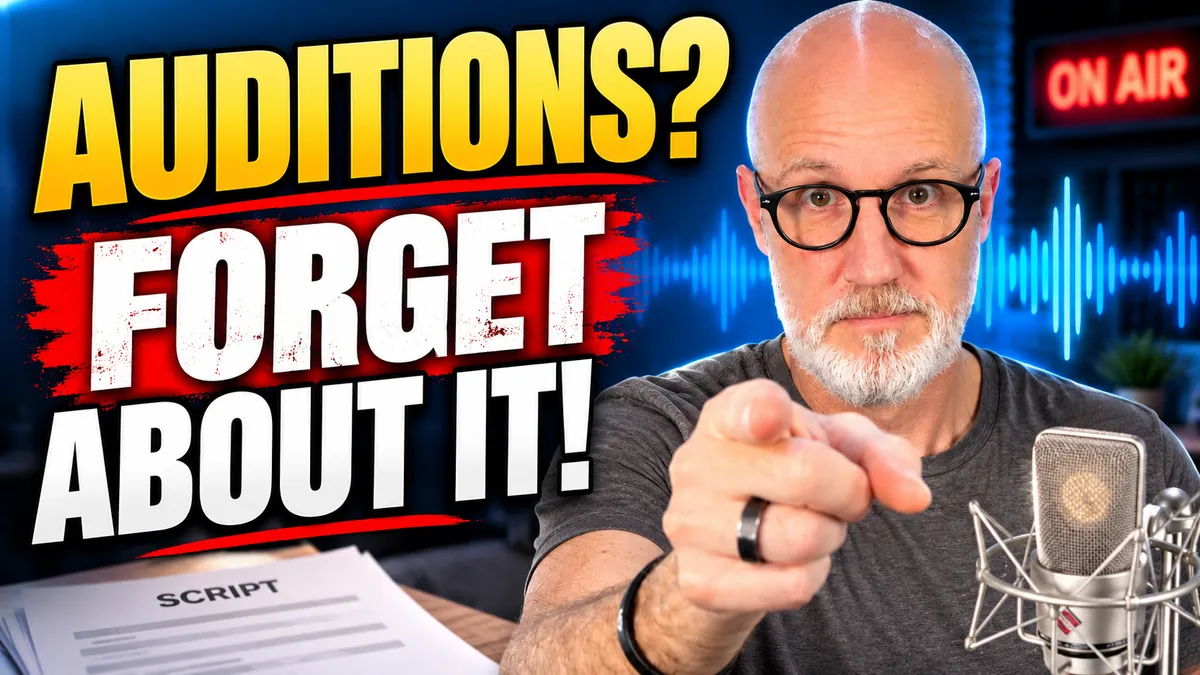
Forget That Audition. Here’s Why.
Forget That Audition. Here’s Why
The Voiceover Audition Rule: Submit It and Forget About It
You know that voiceover audition you just did for your agent?
Forget about it.
That audition you submitted on a pay-to-play site?
Forget about it.
That audition you thought you absolutely nailed and were sure you were going to book?
Yep.
Forget about that one, too.
One of the best habits you can develop as a working voice actor is learning to completely let go of an audition the moment you submit it.
Record it. Do your best work. Send it.
Then move on.
Because the time you spend wondering whether they liked your audition, listened to it, shortlisted you or are about to contact you is time you could be spending finding your next opportunity.
Auditions Are the Lifeblood of a Voiceover Business
As voice actors, one of our jobs is to get ourselves in front of as many legitimate opportunities as possible.
Those auditions can come from all kinds of places.
Maybe your agent sends you an audition.
Maybe it comes through a pay-to-play platform.
Maybe it's through a freelance platform.
Maybe you're on a production company's voiceover roster.
Maybe it's a direct client who already knows your work and wants you to audition for a new project.
Regardless of where the audition comes from, your job is basically the same:
Give them your best read and submit it.
After that?
It's out of your hands.
Stop Checking Your Auditions
It's incredibly tempting to keep thinking about an audition after you've submitted it.
Did they listen to it?
Did they like it?
Did I make the shortlist?
Should I have done another take?
Was my second read better than my first?
Did I interpret that line correctly?
When are they going to make a decision?
Are they going to contact me?
You can burn a tremendous amount of mental energy thinking about something you can no longer control.
And here's the reality of auditioning for voiceover:
Most of the time, you're never going to hear anything back.
You're probably not going to get a detailed email explaining why somebody else was selected.
You're probably not going to get feedback on your performance.
Nobody is necessarily going to tell you that you were one of the final three.
Most of the time, you submit the audition and hear absolutely nothing.
Unless you book it.
If You Book It, You'll Know
This is the part I want voice actors to remember.
You don't need to constantly check on an audition because if you book the job, they'll find you.
Your agent will contact you.
The casting platform will notify you.
The client will email you.
The production company will reach out.
However that audition came to you, there's going to be a way for them to contact you if you're selected.
Trust me.
If somebody wants to hire you, they're going to let you know.
Until that happens, there's nothing else you need to do with that particular audition.
Go find another one.
Volume Matters in Voiceover
As your voiceover business grows, you're probably going to start doing more auditions.
There are days when I might do 20 auditions in a single day.
When you're working at that kind of volume, you don't have time to become emotionally invested in every individual submission.
Imagine submitting 20 auditions and then repeatedly checking every one of them.
Did they listen?
Did they shortlist me?
Has the job been awarded?
Who booked it?
You'd spend half your day monitoring old opportunities instead of looking for new ones.
That's backwards.
Your energy should be focused primarily on the opportunities in front of you—not the ones you've already submitted.
Treat the Audition Like the Job
There's an important distinction here.
When I say "forget about the audition," I don't mean you shouldn't care about it.
Quite the opposite.
While you're recording the audition, give it your full attention.
Read the specs.
Understand what the client is asking for.
Interpret the script.
Make choices.
Give them the best performance you can.
Make sure your audio sounds professional.
Then submit it.
That's the moment when you stop caring about the outcome.
You control the quality of your audition.
You don't control the casting decision.
Those are two very different things.
Why Didn't I Book It?
One of the hardest things about voiceover auditions is that you usually don't know why you weren't selected.
Maybe the client wanted a slightly younger sound.
Maybe they wanted something warmer.
Maybe they decided they wanted something more authoritative.
Maybe your performance was excellent, but another voice simply fit the project better.
There are countless reasons why one voice actor might be selected over another.
That's why I don't think it's particularly productive to obsess over every audition you don't book.
Instead, look at your performance over a much larger sample.
If you've submitted a substantial number of auditions and aren't getting any traction, then it might be worth examining your performance, audio quality, audition technique or the opportunities you're pursuing.
But don't let one audition determine how you feel about your abilities.
One Problem With Auditions: You Rarely Hear the Competition
There's another challenge with voiceover auditions that makes it difficult to evaluate yourself.
You usually don't know who you're competing against.
You send your audition into the world, and that's it.
You don't hear the other 20, 50 or 100 people who may have auditioned for the same project.
You usually don't hear the person who booked it either, unless you happen to come across the finished spot later.
That's why I run a monthly audition contest inside The Voiceover Blueprint.
I upload a real script from a real spot and have our members submit their best reads.
After the submission deadline, I choose a winner.
The winner receives an audio/video demo of the spot that they can use in their marketing.
But there's another benefit to the exercise.
Everyone gets an opportunity to hear how other voice actors interpreted the exact same copy.
That's something you normally don't get when auditioning professionally.
You can hear different approaches.
Different pacing.
Different interpretations.
Different choices.
And then you can hear the winning read and compare the different approaches.
It's a great reminder that there isn't always one obvious way to interpret a piece of copy.
Don't Measure Your Career One Audition at a Time
This might be the biggest takeaway.
Voiceover is a numbers business.
You're going to submit auditions you don't book.
A lot of them.
That's normal.
So don't measure your progress based on whether you booked the audition you recorded this morning.
Look at the bigger picture.
Are your performance skills improving?
Are you becoming faster and more efficient?
Are you getting better opportunities?
Are you auditioning consistently?
Are you expanding the number of places where you're finding those opportunities?
Are you booking work over time?
That's much more useful than obsessing over a single audition.
Record It. Submit It. Forget About It.
That's the system.
Record the audition.
Give it your best performance.
Submit it.
Make sure everything has been uploaded correctly and you've followed the instructions.
Then...
Forget about it.
Don't spend the afternoon wondering if they liked it.
Don't keep checking whether someone listened.
Don't try to predict whether you made the shortlist.
Take that energy and put it into finding the next audition.
Because if you booked the job, they'll let you know.
And until then?
Your next audition is more important than your last one.
Want to Learn More About Voiceover?
If you're interested in becoming a voice actor but aren't sure where to start, I host a free Voiceover Blueprint webinar every Tuesday at 6:00 p.m. Pacific Time on Zoom.
You can learn some of the steps involved in starting a voiceover business and ask me your questions about the industry.
You'll also receive a free digital and audiobook copy of my book, The Voiceover Blueprint, plus four additional free gifts just for attending.
You can register using the link in the description or pinned comment on my YouTube channel.
And if you're already auditioning but need more opportunities, I've also created a complete video about how to find more voiceover auditions and where to look for them.
Because once you've learned to submit an audition and forget about it, there's really only one question left:
Where's the next audition?
Download My Latest Beginner Mistakes in Voice Over - Quick Start! https://thevoiceoverblueprint.com/beginner-mistakes
Discover the Voice Over Blueprint™: https://thevoiceoverblueprint.com/vobp
The content on this channel is for educational and informational purposes only. While I share tips, strategies, and guidance based on my experience as a professional voice actor, there is no guarantee of earning income or securing voiceover work by using the information provided. Results vary depending on individual effort, skill level, market conditions, and other factors. Viewers should use their own judgment and take personal responsibility for their voiceover career decisions.

Download my latest voice over resource guide...
Get My Latest Voice Over Tips, Tricks, and Insights You Can Use Right Now!
These no cost resource guides show you what working now in voice over.
Terms of Use. |. Disclaimer. |. Privacy Policy. |. Members Area. | Reviews | Refund Policy | Partners