

Voice Over Content Hub
Welcome to the content hub.
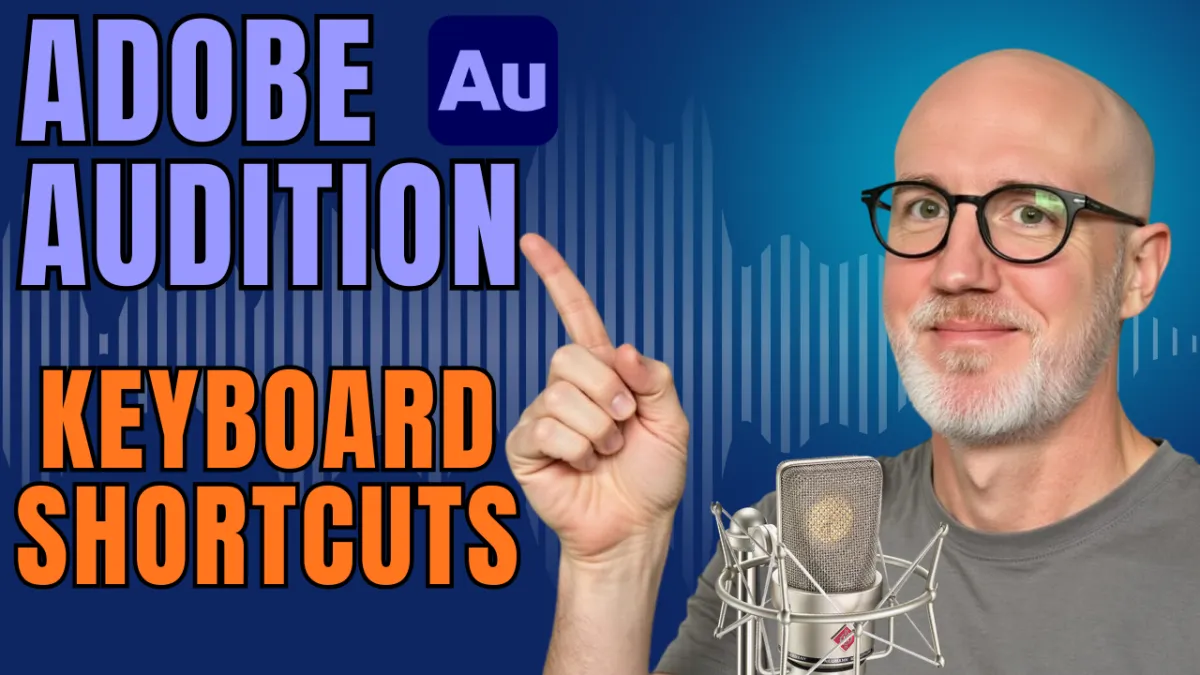
Faster Voiceover Editing in Adobe Audition
Faster Voiceover Editing in Adobe Audition
Adobe Audition Keyboard Shortcuts: How Voice Actors Can Edit Audio Faster
If you're a voice actor, chances are you spend a significant amount of time editing audio. Whether you're recording commercials, audiobooks, e-learning projects, or corporate narration, every click and every extra step adds up over time.
The good news?
Adobe Audition has built-in keyboard shortcuts and macros that can dramatically speed up your editing workflow.
If you've been navigating menus every time you want to denoise, save a file, or apply processing, you're wasting valuable time. By customizing keyboard shortcuts, you can complete common editing tasks with a single keystroke.
Here's how to make Adobe Audition work smarter for you.
Why Keyboard Shortcuts Matter
There's an old saying:
Time is money.
That's especially true in voiceover.
The faster you can edit your recordings while maintaining quality, the more projects you can complete—and the more profitable your business becomes.
Instead of constantly clicking through menus, keyboard shortcuts let you:
Apply effects instantly
Open new files faster
Save recordings with one key
Remove clicks and noises more efficiently
Process entire files in seconds
The time savings may seem small at first, but over hundreds of projects, they add up in a big way.
Create Custom Favorites First
Before assigning a keyboard shortcut, you'll first need to create a Favorite in Adobe Audition.
Favorites allow you to save commonly used effects or processing chains so they can be recalled instantly.
For example, if you regularly use a specific delay, EQ, or compression setting:
Open the desired effect.
Adjust the settings.
Click the Favorite (star) icon.
Save it with a memorable name.
Once it's saved as a Favorite, you're ready to assign a keyboard shortcut.
Assign a Keyboard Shortcut
After creating your Favorite:
Open Keyboard Shortcuts.
Expand the Favorites section.
Locate your newly created Favorite.
Click in the Shortcut field.
Press the key you'd like to use.
Save your changes.
Now, instead of opening menus every time, you simply press a single key to apply that effect.
The best part?
Choose shortcut keys that are easy to remember.
For example:
R for a favorite reverb
N for noise reduction
S for save
M for master processing
The more logical your shortcuts are, the easier they'll become to remember.
Don't Stop at Effects
Many voice actors only create shortcuts for audio processing.
That's a missed opportunity.
Adobe Audition lets you assign shortcuts to many everyday tasks, including:
Opening a new audio file
Saving recordings
Applying silence
Running denoise
Auto Heal
Favorite effects
Custom processing
Every menu item you eliminate is one less interruption to your creative workflow.
One of My Favorite Shortcuts: Auto Heal
If you record voiceover regularly, you'll eventually encounter:
Mouth clicks
Small pops
Tiny audio glitches
Adobe Audition's Auto Heal feature is incredibly useful for repairing those little imperfections without manually redrawing waveforms.
Since it's a tool you'll probably use frequently, assigning it to an easy-to-reach keyboard key can save a surprising amount of time over the course of a project.
Take It One Step Further with Macros
Keyboard shortcuts are powerful.
Macros are even better.
A macro lets you execute multiple processing steps automatically with a single keypress.
Instead of applying effects one by one, you can build an entire processing chain that runs automatically.
For example, your macro might include:
Noise reduction
Click removal
EQ
Compression
De-essing
Loudness processing
Once recorded, Adobe Audition can perform every one of those steps in sequence with a single shortcut.
How to Record a Macro
Creating a macro is straightforward.
Inside Adobe Audition:
Go to Favorites.
Choose Start Recording Favorite.
Perform each processing step in the desired order.
Select Stop Recording Favorite.
Name the macro.
From then on, you can assign it to a keyboard shortcut just like any other Favorite.
Instead of clicking through five or six effects every time you finish recording, one keypress handles the entire workflow.
Build Consistency into Every Recording
Another advantage of macros is consistency.
Every recording receives:
The same EQ
The same compression
The same click removal
The same processing order
That consistency helps maintain a professional sound across all of your projects.
Just remember:
Before creating a master macro, make sure you've worked with an experienced audio engineer—or spent the time dialing in your processing chain—so you're automating settings that actually sound good.
Develop Muscle Memory
At first, using keyboard shortcuts may feel awkward.
You'll probably forget which key does what.
Stick with it.
Over time, your fingers begin to remember.
Eventually, you'll find yourself editing without even looking down at the keyboard.
That's when your workflow really starts to accelerate.
The goal is to spend less time thinking about software and more time focusing on your performance.
Final Thoughts
Every voice actor wants to work more efficiently.
Keyboard shortcuts and macros are two of the easiest ways to speed up your Adobe Audition workflow without sacrificing quality.
Instead of navigating menus dozens—or even hundreds—of times each week, build a system that lets Adobe Audition do the repetitive work for you.
Start by creating shortcuts for the tasks you perform every day.
Then graduate to macros that automate your entire processing chain.
The result?
Faster editing.
More consistent audio.
And more time to focus on what really matters—recording great performances.
If you're serious about building a professional voiceover business, small workflow improvements like these can make a surprisingly big difference over time.
Ready to take the next step? I'm hosting a free 1-hour webinar this Tuesday night at 6:00 PM Pacific / 9:00 PM Eastern where I'll go deeper into everything it takes to start a voice acting career from home—including how to land your first gigs with little to no upfront cost. Plus, everyone who shows up gets a free copy of my book, The Voiceover Blueprint (audiobook and ebook). Sign up using this link.
Download My Latest Beginner Mistakes in Voice Over - Quick Start! https://thevoiceoverblueprint.com/beginner-mistakes
Discover the Voice Over Blueprint™: https://thevoiceoverblueprint.com/vobp
The content on this channel is for educational and informational purposes only. While I share tips, strategies, and guidance based on my experience as a professional voice actor, there is no guarantee of earning income or securing voiceover work by using the information provided. Results vary depending on individual effort, skill level, market conditions, and other factors. Viewers should use their own judgment and take personal responsibility for their voiceover career decisions.

Download my latest voice over resource guide...
Get My Latest Voice Over Tips, Tricks, and Insights You Can Use Right Now!
These no cost resource guides show you what working now in voice over.
Terms of Use. |. Disclaimer. |. Privacy Policy. |. Members Area. | Reviews | Refund Policy | Partners